Grant programs have a language of their own, and it can make a simple funding opportunity feel needlessly complicated. This glossary translates the terms you will actually meet in Canadian grant applications into plain English. Skim it, search it, or bookmark it for the next time a program asks for something you have never heard of.
We have grouped the terms by where they show up: the basics, the kinds of funding, the application, how the money works, and what happens after you win.
Table of Contents
The Basics
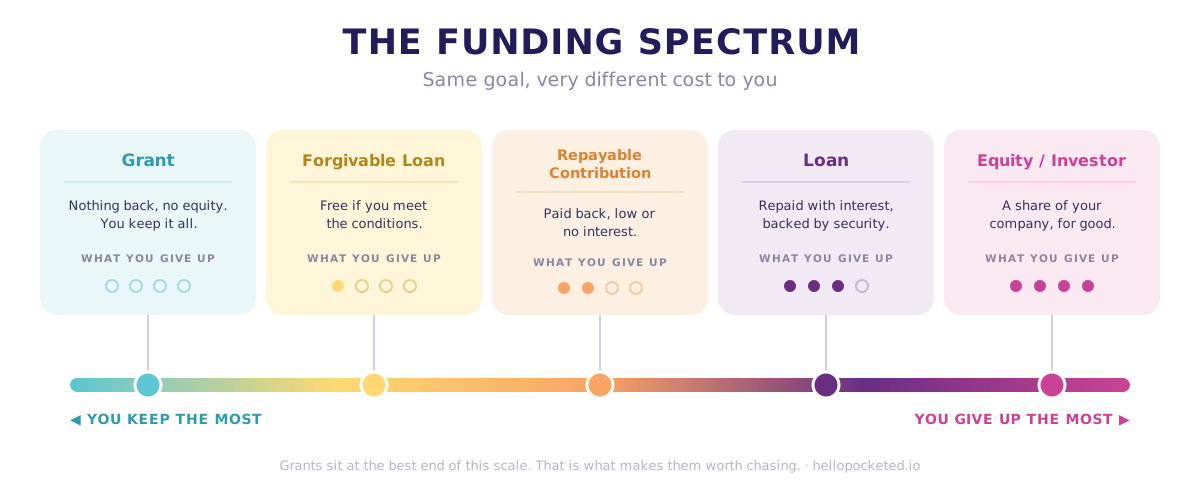
Grant: Funding you do not have to pay back, as long as you use it as agreed and meet the program’s conditions. It is the goal for most businesses because it adds money without adding debt or giving up ownership.
Non-dilutive funding: Any funding that does not cost you a piece of your company. Grants are non-dilutive, which is what makes them so valuable. You keep 100% of your equity.
Funder (granting agency): Whoever’s money it actually is. On the government side this is a federal, provincial, or municipal department or agency. Funding can also come from outside government, such as foundations and corporations, which we cover in Government vs. Non-Government Grants.
Delivery organization: The partner that runs a program on the funder’s behalf, receives applications, and selects recipients. It sits between you and the funder. For example, ICTC delivers the WIL Digital wage subsidy, and BioTalent Canada delivers the Student Work Placement Program for life sciences.

Kinds of Funding (and Their Look-Alikes)
R&D grant: Funding that offsets the cost of developing a new product, process, or service, so you can take on technical work you could not otherwise afford.
Hiring grant / wage subsidy: Funding that covers part of an employee’s wages, lowering the cost of growing your team. Many are tied to specific groups, such as students or youth.
Training grant: Funding that helps you upskill or retrain existing staff rather than hire new people.
Market expansion / export funding: Funding that offsets the cost of entering new markets, often international ones. It is one of the most underused categories, so it is worth a look.
Tax credit: Funding delivered through the tax system rather than as a cheque. A refundable tax credit like SR&ED pays out even if you owe no tax, returning up to 35% of eligible R&D. A non-refundable credit can only reduce tax you actually owe.
Contribution: Close to a grant, but conditional. Contributions come with performance terms set out in advance, heavier reporting, and sometimes an audit. They can be repayable or non-repayable.
Repayable contribution: A contribution you pay back, usually with no or low interest. Think of it as a subsidized loan rather than free money. AgriInnovate is one example.
Forgivable loan: A loan that converts into money you keep if you meet certain conditions, such as creating a set number of jobs. Hit the targets and it behaves like a grant.
Loan: Borrowed money you repay, usually backed by security such as an asset or a personal guarantee. Useful, but it is debt, not a grant.
Investor / equity funding: Money in exchange for a share of your company. It is the opposite of non-dilutive funding, since you give up ownership to get it.
Bursary: A need-based award, almost always in an education context for students. You will see the word around, but it rarely applies to businesses.
The Application
Application: The package you submit to be considered, made up of forms, supporting documents, and attachments. It is what gets you the money.
Eligibility: Whether you and your project actually qualify, based on things like your business type, size, location, stage, and what you plan to spend on. Always the first thing to check.
Eligible costs: The specific expense categories a program will fund. A program might cover salaries but not equipment, or new costs but not ones you already incurred, so read this carefully.
Net-new: A cost or hire that adds to your existing baseline rather than replacing something. Many wage subsidies only fund net-new positions, meaning you are growing headcount, not backfilling.
Expression of Interest (EOI) / Letter of Intent (LOI): A short pre-application that screens your fit before you invest time in a full submission. Pass it and you are invited to apply in full.
Intake: An application window. Some programs run on fixed deadlines, some accept applications on a rolling basis, and some are first-come, first-served until the money runs out.
Granting cycle: How often a program opens. Most run somewhere between one and four times a year, each with its own application period.
Contribution agreement (or award agreement): The contract you sign once approved. It spells out your funding, your obligations, the reporting schedule, and the conditions for getting paid.
How the Money Works
Cost-share (matching): The portion of a project you must cover yourself. If a program funds 50% of a $40,000 project, your cost-share is the other $20,000, which you can sometimes cover with another program.
In-kind contribution: Non-cash resources you put toward a project, such as staff time or equipment, which some programs let you count toward your cost-share.
Stacking: Combining more than one program on the same project. It is allowed and encouraged, but total government support generally cannot exceed 75% of eligible costs, and you cannot fund the same expense twice.
Disclosure: Your obligation to tell each funder about all other government funding you have received or applied for. Skipping it is treated as misrepresentation and can trigger a clawback.
Reimbursement: Payment that arrives after you have spent the money and reported the costs. Many programs work this way, which means you need cash on hand to front the expenses first.
Disbursement / advance: Payment that arrives up front or in installments rather than after the fact. Not every program reimburses in arrears, so check how and when yours pays.
Holdback: A portion of your funding the funder keeps back until your final report is reviewed and approved.
Clawback: Money a funder can require you to repay if you break the terms, exceed the stacking limit, or fail to disclose other funding. The reason disclosure and clean records matter.
After You Win
Reporting: The updates you provide throughout a project, covering both your spending (with receipts and paystubs) and your results. No reports usually means no payment, so build the habit early.
Project period: The window during which your costs are eligible. Spend before it starts or after it ends and that spending typically will not count.
Still stuck on a term, or not sure which programs you qualify for? Pocketed’s matching platform does the translating for you, and our guide on how to choose the right grant puts these terms to work.